






HANCOCK COUNTY — When you toss a soda can in a recycling bin, there’s a good chance it makes it to a facility in Indianapolis, which sorts and compiles the aluminum container with countless others into a massive bale.
That bale gets shipped to facilities like one in Warrick County, where old cans are used to make aluminum sheeting for new ones.
Waste management companies are getting far less money for those tossed cans than they used to, along with other recyclables Americans regularly put out on the curb. On top of that, they’re having to invest more in processing to ensure fewer pieces are contaminated with materials that can’t be recycled.
Story continues below gallery
Click here to purchase photos from this gallery
China, once a major importer of recyclables from across the world, used to accept shipments with non-recyclable material, as long as it didn’t exceed 3% of the load. That’s 60 pounds per ton. In 2017, the country changed its contamination limit to 0.5%, or 10 pounds per ton.
According to industry data, as many as one in four items tossed into a recycling bin is not actually recyclable. Contamination takes many forms, from recyclables closed up in plastic bags to food waste to pieces that simply aren’t recyclable.
The changes have drastically altered the recycling market, increasing expenses and decreasing the value of the material you leave at your curb or drop off at your neighborhood recycling site. The result, experts say, is an increasingly difficult market where the cost to recycling companies is becoming prohibitive.
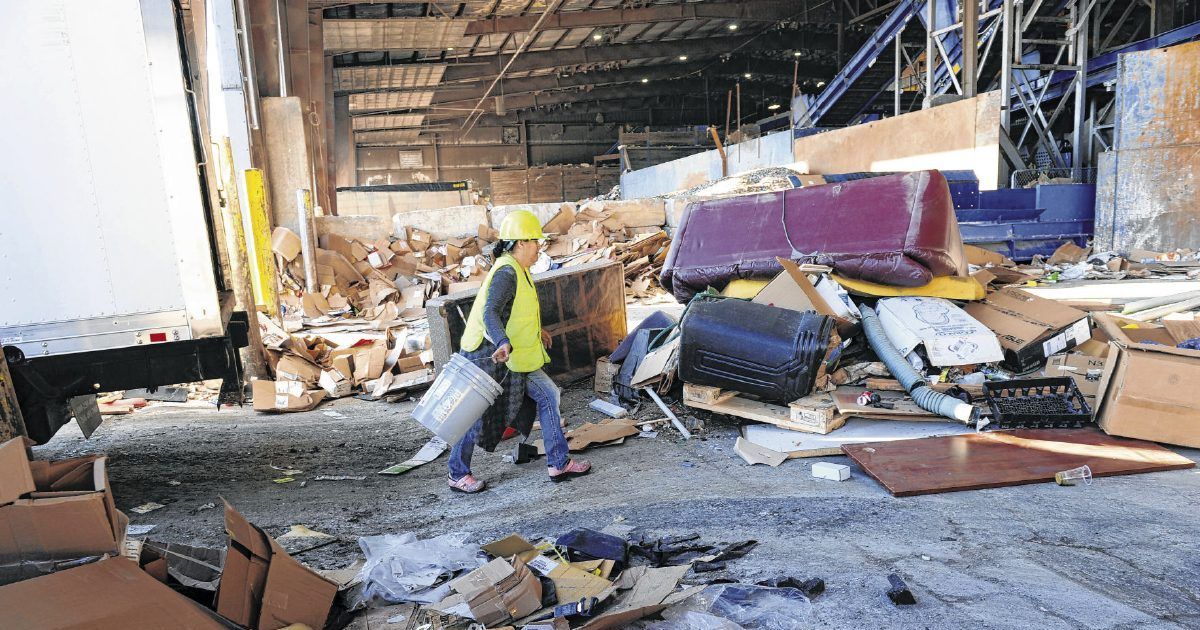
When one of those companies, Republic Services, picks up recyclables from its customers in Hancock County, the company hauls them to its materials recycling facility in Indianapolis. The facility sorts cardboard, paper, plastic bottles and jugs, aluminum and steel cans and glass.
Craig Lutz, area senior manager of municipal sales for the Great Lakes area with Republic Services, said China’s changes force facilities like the one in Indianapolis to slow down its process and add pre-sorters on the front end and quality-control inspectors on the back end to ensure less contamination.
The shift also resulted in China importing a lot less recyclable material, causing an influx domestically, Lutz said. As the supply rose and demand remained the same, prices fell. Republic Services used to get $150 a ton for cardboard. Now it gets $30 a ton.
Those former high prices have always supported recycling on the industry’s back end, Lutz said. Now that prices have plummeted, that support needs to come from elsewhere.
“We’re asking people that want to do recycling, that believe in recycling, to help support that on the front end as well,” he said.
Republic Services continues to believe in recycling, Lutz said, adding the company invested more than $6 million into its Indianapolis plant at the end of 2018 to adapt to the changes affecting the industry.
“We believe in the market and we believe in the industry; we just need to make sure that everybody buys in, so to speak, and supports it economically, environmentally, educationally, so these programs can be durable to the public, because I think the public wants it.”
Allyson Mitchell, executive director of the Indiana Recycling Coalition, said China accepted a lot of low-quality recyclables before bolstering its contamination limits.
“It was a big wake-up call,” she said. “Honestly, it was overdue.”
Most U.S. states are feeling the pinch more than Indiana, Mitchell said, because they’re feeling it on two ends — not only lower values for recyclables, which affects everyone, but also a lack of end markets. Indiana is insulated from the latter with its heavy manufacturing sector.
“We got end markets for all the commodity materials in the recycling bin,” she said. “We’re not immune to the commodity value bottoming out. That’s something we can’t escape.”
Pratt Industries in Valparaiso uses recycled paper to make boxes and displays. Crawfordsville-based Nucor Steel uses recycled steel to make its products. Aluminum cans go to Alcoa in Warrick County. Ardagh has glass manufacturing plants in Dunkirk and Winchester. Knauf Insulation in Shelby County also uses recycled glass in its products. Mitchell said there are processors in Indiana that take recycled plastics and melt them into pellets before selling them as a commodity to customers like vehicle manufacturers, who use the pellets to make parts.
Those facilities and Indiana’s strong transportation networks soften the blow left by the weakened markets, Mitchell said.
Too much of the onus on recycling is placed on consumers, she also said, adding sharing that obligation can help further improve the industry.
“We have set up a system in this country where we put almost all of the responsibility on consumers,” she said.
Others have a responsibility too, she continued, like product material designers, who could choose materials with higher recycling capabilities over those that are more visually appealing.
“The consumers aren’t going to bail us out of this,” Mitchell said. “We all have a role to play.”
She’s optimistic regardless of all the challenges.
“Despite all the bad news that is in the recycling industry now, this is a really exciting time to be in it in Indiana,” Mitchell said. “We have all the components of weathering this storm and turning it into an economic opportunity to generate jobs and generate economic opportunities within our state.”
She’s encouraged by the Indiana Department of Environmental Management’s recent request for proposals for a research study to assess the nature and extent of recycling markets and resources in the state.
Kent Fisk is president of Greenfield-based Fisk Waste Removal, which offers curbside recycling pickup in the city. He has a less favorable outlook on end markets than Mitchell, explaining his company did a lot of work in recycling in the 1990s, when more domestic companies accepted recyclables.
Now, most recyclable materials collected in the country are not used here, Fisk said, making the market “extremely volatile.”
The company that Fisk Waste Removal takes its cardboard to paid $180 a ton for it two years ago. Now, it pays nothing. Materials recycling facilities used to take Frisk’s recyclables for free. Now they charge about 75 percent of what it would cost to dump in a landfill.
“There is not a lot of savings between landfill bills and what we pay to get rid of the recyclables,” Fisk said. “It didn’t used to be that way. They used to take them for free and they would deal with the imperfections.”
There’s too much international influence these days, he said, and not enough domestic use of recyclables.
“Right now it’s a bad deal,” Fisk said. “It probably wouldn’t hurt anybody if all the recycling got shut down and started up again in some better way.”
Dede Allender is program coordinator for the Hancock County Solid Waste Management District and also works for the county’s Purdue Extension. She said she has redirected her teaching topics to stress the “reuse” part of the “reduce, reuse, recycle” slogan.
Her programs teach kids what items can be recycled and how the recycling process works. She said she would always have some kids who said their parents didn’t want to pay for recycling, so she decided to emphasize the free act of reusing.
“By going the route of reuse rather than replace/dispose, we can achieve basically the same goal, without the cost,” Allender told the Daily Reporter in an email.
She encourages taking reusable lunch containers to school and work, using reusable shopping bags, buying items with less packaging and fixing broken items as opposed to replacing them.
“If we reuse as much as we can, we will have less trash and less recycling to worry about,” she said.
Recycling reminders
- Know what to throw — cardboard, paper, metal cans, plastic bottles and jugs
- Keep recyclables empty, clean and dry
- Don’t bag it
- When in doubt, throw it out
Source: Republic Services










