






But Mr Charlton argued that a fall in imports through Sydney’s Port Botany (which reflects weaker consumer spending) appeared to have “bottomed out” and he was hopeful of an economic recovery.
Across the company’s Sydney tollroads, average daily traffic rose 2.2 per cent in the first half, with a 2.8 per cent rise in car traffic countering a 3.7 per cent drop in truck traffic.
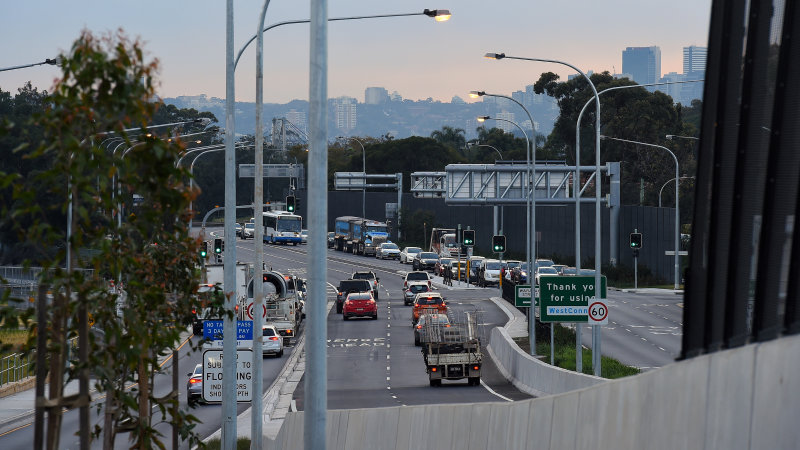
The 2.2 per cent increase included traffic along the newly tolled M4 in western Sydney which Transurban acquired as part of its $9.3 billion acquisition of a 51 per cent stake in WestConnex in 2018.
Excluding the M4, which Transurban said had been performing better than expected since opening in July 2019, traffic fell 0.1 per cent.
Traffic rose 1.1 per cent on Melbourne’s CityLink in the six months to December and was up 4.4 per cent on Brisbane’s Gateway Motorway.
Proportional earnings before interest, taxation, depreciation and amortisation (EBITDA) which measure income relative to Transurban’s ownership stakes in its toll road assets, rose 9.5 per cent to $1.1 billion, but were weaker than analysts expected. The figures excludes significant items, including costs related to its WestConnex acquisition in 2019.
But analysts were happy with the company’s strong cash flows, with proportional free cash rising 30 per cent to $927 million. Transurban’s stock rose 13¢, or 1 per cent, after markets opened on Tuesday to trade at record highs of $16.23.
Transurban said it was actively working with contractors CIMIC and John Holland in Melbourne and the Victorian government to resolve a dispute over the construction of the $6.7 billion West Gate Tunnel tollroad, but warned that the project’s schedule was “under review.”
Mr Charlton said that Transurban believed it was still possible to build the road by its forecast completion date of 2022, but on the current schedule, it was unlikely to be completed by that date.
The WestGate tunnel project was initiated by Transurban and the company has to date spent $2 billion on the new road. Tunneling was supposed to start in mid-2019, but due to a delay in tunneling machines being ready, the start date was pushed back to September-October.
The contractors last month terminated their fixed-price contract with Transurban, claiming they were not responsible for the unexpected cost and difficulty of disposing of contaminated soil, after new policies were introduced by the state Environment Protection Authority on the handling of per-and polyfluorinated alkyl substances (PFAS) – chemicals used in firefighting foams and other industrial and consumer products.
Mr Charlton said there was currently no landfill site that was capable of taking the amounts of contaminated soil that would be removed during tunnelling (which has not started) but that 3-4 potential sites were being explored and talks were ongoing with multiple parties.
If Transurban believed that it would incur material extra costs due to the delay – which could happen if an appropriate site is not found soon – it would make a statement to the Australian Securities Exchange, Mr Charlton said. “We’re not going to comment on commercial arrangements.”
The contract termination has been rejected by Transurban, which has its own fixed price contract with the state government to deliver the project and claims the contract remains valid.
If the parties cannot resolve who will pay for the disposal of contaminated soil, or end up fighting about the validity of the terminated contract, the dispute could end up in the courts.
Transurban said its troubled NorthConnex tollroad project in Sydney, which has been delayed, was expected to open in mid-2020.
Proportional toll revenues rose 8.6 per cent to $1.4 billion in the six months to December.
Transurban will pay an interim dividend of 31¢ per share, up from 29¢ per share a year earlier. The company reaffirmed guidance for a full year dividend of 62¢ per share.










