







New concerns are emerging about Canadian access to U.S. government contracts under the revamped North American trade pact, even as Parliament ponders a report showing limited economic gains to be had as a result of the deal.
Government procurement has long been an irritant between Canada and the U.S. and was among the thorniest issues tackled in the talks leading to the $1.2-trillion deal known as the Canada-U.S. Mexico agreement or “USMCA” in Washington and “CUSMA” in Ottawa.
In the end, Canada gave up the provisions on U.S. government procurement it held under the original NAFTA, relying instead on the World Trade Organization’s Government Procurement Agreement or GPA — a 47-country deal, including the U.S., that aims to open access between member countries on a reciprocal basis.
Now, U.S. President Donald Trump’s administration is pondering a potential exit from the GPA if it isn’t reformed, Bloomberg reported earlier this month. And the idea has the backing of U.S. Trade Representative Robert Lighthizer who favours an approach to procurement through bilateral deals, according to a subsequent report from the trade publication Inside U.S. Trade.
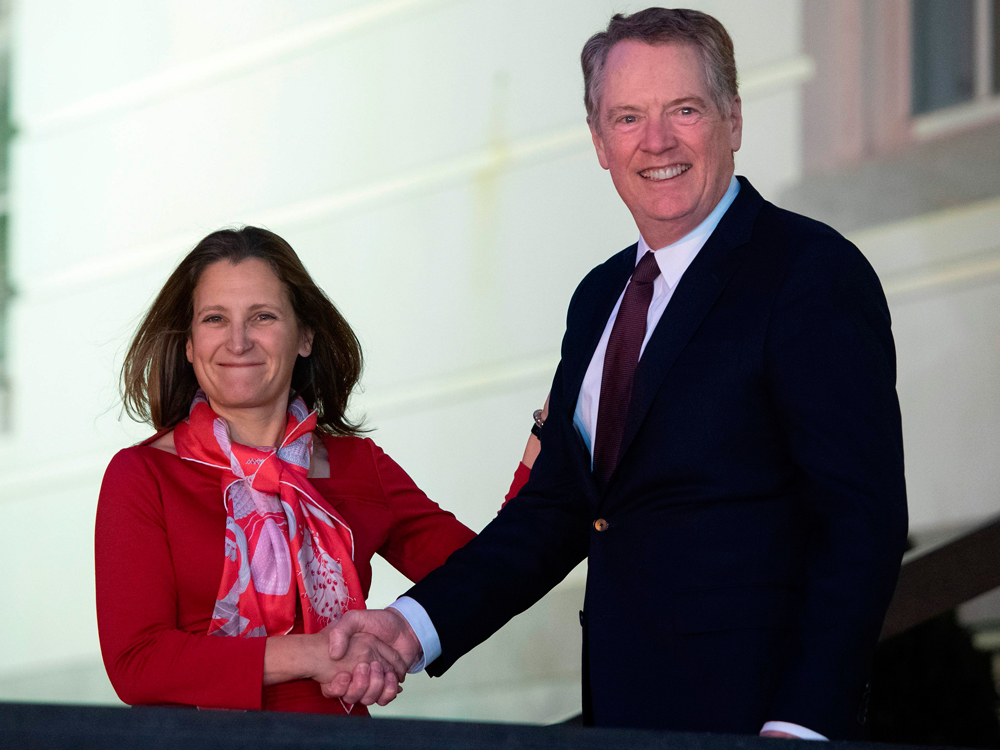
Though the White House has yet to make an official statement on a potential withdrawal from the GPA, a spokesperson for Deputy Prime Minister Chrystia Freeland said she’d raised the issue with Lighthizer in a meeting on Feb. 7. The spokesperson would not comment on whether the U.S. had offered any reassurances regarding Canadian access to government contracts.
“Canada’s reasoning was sound because the rules under the GPA were actually better than what was in the original NAFTA,” said Inu Manak, a trade policy expert at the Cato Institute in Washington-D.C. “So if the U.S. does this, it really is like pulling the rug out from under Canada’s feet. This is definitely not what Canada wanted.”
Of US$12 billion in U.S. government contracts granted to foreign companies in 2015, roughly 5 per cent or US$623 million went to Canadian firms, according to a report from the U.S. Government Accountability Office. The largest share went to the European Union at US$2.8 billion, followed by Japan at US$1.1 billion.
If the U.S. does this, it really is like pulling the rug out from under Canada’s feet. This is definitely not what Canada wanted


The impact of a U.S. withdrawal from the GPA was absent from a Canadian government economic impact assessment released Wednesday. That report predicted modest gains for Canada as a result of the revamped NAFTA, with economic output increasing by $6.8 billion, or 0.25 per cent versus a scenario in which there was no agreement at all.
The assessment, which identifies “preservation” of key elements as an overarching objective for negotiations, was swiftly criticized for weighing the deal against the prospect of no trade agreement and ongoing tariffs on Canadian steel and aluminum, rather than against the original NAFTA. A previous assessment by the U.S. International Trade Commission was similarly critiqued by some economists for assessing a positive impact of the deal due to its removal of trade “uncertainty.”
“We normally do not assess trade agreements by comparing them to a hypothetical, terrible scenario and then say ‘this is better than that,’” said Jennifer Hillman, a senior fellow for trade and international political economy at the Council on Foreign Relations. “The traditional approach is to compare the baseline to what exists today and then explain the change. So it’s strange.”
Most economic assessments of the new NAFTA have found its net impact to be negative, compared to the status quo under the original trilateral deal. Indeed, a recent study from the CD Howe Institute found the pact would lower real GDP and welfare for all three countries, with Mexico taking the hardest blow and the U.S. the lightest.
Canadian real GDP will fall by 0.40 per cent and economic welfare by US$15.3 billion, according to the study by trade analyst Dan Ciuriak, who co-authored the report with colleagues Ali Dadkhah and Jingliang Xiao. Much of that loss is attributed to new rules of origin in the deal’s automotive chapter that require a large percentage of metal and parts to be sourced from North American suppliers. Still, all three parties are better off than if the deal lapses, the report notes.
“It’s a way of presenting it that’s positive,” Ciuriak said of the government assessment. “There’s an element of politics of course because governments don’t like to explain a negative number.”
Still, Ciuriak felt the assessment was fair, given the unpredictability of Trump’s threat to withdraw from NAFTA. And in a separate report for the CD Howe Institute comparing the new NAFTA to “no-NAFTA,” Ciuriak’s estimate of the economic effect was roughly in line with the government’s.
Others have argued that economic modelling fails to capture some of the largest benefits of the deal, including the establishment of new committees to smooth trade wrinkles at the border and a new system for thwarting illegally traded steel.
“Those things aren’t captured in an economic report,” said Lawrence Herman, an international trade lawyer based in Toronto. “Nor are the political and strategic benefits of being in a trade relationship with the U.S.”
The Trump administration has repeatedly threatened to withdraw from multilateral deals or impose tariffs in order to gain leverage in negotiations with trading partners. A unilateral withdrawal from NAFTA was repeatedly threatened by Trump throughout negotiations on the deal, even as trade experts questioned his authority to take such a step.
With Canada the only country yet to ratify the new pact, Ottawa could use its power to demand some reassurances on government procurement, said Edward Alden, a senior fellow at the Council on Foreign Relations.
“I do think Canada has some leverage here and this is a serious issue,” he said. “President Trump wants to run for election in 2020 on a complete and ratified USMCA. So I imagine Canadian officials are having some serious conversations about this.”
Financial Post
• Email: [email protected] | Twitter: naomi_powell










