






De La Rue, the company that supplies banknotes to the Bank of England, is in trouble. In November, it reported a half-year loss of £9.2m ($12.11m), and net debt of £170.7m ($224.61m), up from £118.8m ($156.32m) only 6 months before. The company is bleeding money: in the last six months, £32.2m ($42.37m) has flowed out of its coffers. And it is close to breaching its banking covenants, the conditions set by its lenders that mean its net debt must not exceed three times its earnings before interest and taxation. If it does, the lenders could force it into administration, the U.K.’s equivalent of Chapter 11 bankruptcy.
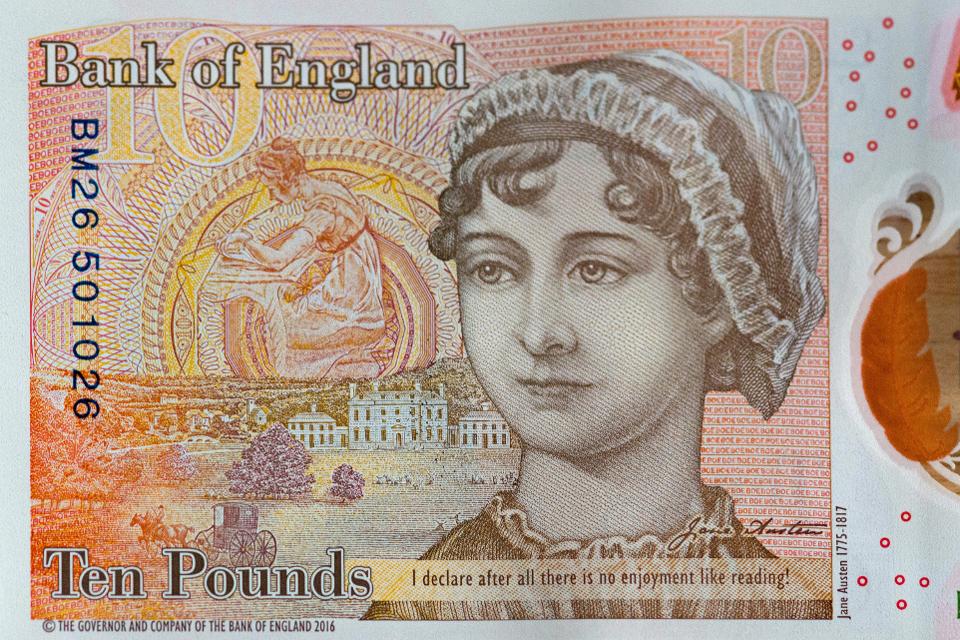
Close up of the new UK ten pound note released into circulation 14 Sep 2017.
Founded in 1813, De La Rue has a long history of producing distinctive stationery for governments, including railway tickets, stamps, passports and banknotes. It is currently the world’s largest producer of passports, though it has recently lost its contract to produce passports for the British Government. By far its largest business line, however, is banknote production. In 2018/19, this contributed 77% of revenue and 61% of adjusted profit.
Because of this, lots of people assume that De La Rue’s difficulties are structural – and terminal. After all, if three-quarters of your revenue comes from printing banknotes, and demand for banknotes is falling, you must surely be on your way out. “It’s obvious we are moving to a cashless world,” said one contact. “In these days of e-payments and cryptocurrencies, do we even need companies like this any more?”
But demand for cash isn’t falling at anything like the rate needed to cause such a dramatic crash. 84% of global transactions are still in cash. In the U.S., banknote production outstrips GDP growth. And in the U.K., despite predictions that by 2028 physical cash will be used in only 9% of transactions, banknote production is rising.
Nevertheless, De La Rue’s problems do seem to center on its banknote printing business, where revenues have plunged 29.5%. So if this isn’t due to declining use of cash, what is causing it?
The company’s commentary appears to suggest that there has been a one-off shock to banknote production which will eventually resolve itself. But a resilient company shouldn’t be brought to the brink of insolvency by a one-off shock. There must be something else.
And sure enough, there is. A deeper look into the company’s financials reveals a long-standing malaise. Back in 2010, the company reported a healthy before-tax profit of £104.1m ($136.97m). But the following year, profits before taxation had shrunk to £33m ($43.42m) as revenues fell by 17%. Nicholas Brookes, De La Rue’s non-executive chairman at the time, blamed the collapse on “paper production issues, lower than expected banknote print volumes, changes in senior management and a takeover approach.” Tim Cobbold, who had just been appointed as chief executive, announced a detailed improvement plan which would cut costs, streamline processes, invest in technology and improve sales performance. Cobbold said the plan would “generate the value that shareholders rightly look to the Board to deliver.” Anticipating success, the company paid out its entire profits in dividends. And it did so every year thereafter.
But by 2015, the company’s position was significantly worse. Revenue and profits remained much where they had been in 2011, but net debt had soared from £31.2m ($41.05m) in 2011 to £111m ($146.05m), and the company had a pension deficit of nearly a quarter of a billion pounds. Continually paying dividends had taken its toll, too: , shareholder’s equity had fallen to negative £155m ($203.95m). Far from “bringing De La Rue back on track,” Cobbold’s improvement plan had succeeded only in making its future extremely uncertain.
Cobbold’s replacement, Martin Sutherland, devised a strategic plan which he said would achieve “improved profitability, more effective use of capital and reduce the Group’s reliance on a small number of material contracts while reducing some of the volatility of the business.” The chairman, Philip Rogerson, endorsed the plan: “The Group has a clear plan to deliver growth and improved profitability in the long term.” The company continued to pay dividends, though at a lower level than before.
Sutherland’s strategic plan divided the company’s product lines into two groups: the low-growth legacy businesses of paper banknote production, cash sorting and vault management would undergo cost-cutting and streamlining, while investment would be focused into higher-growth business lines using advanced technology. Over the next four years the company concentrated on developing new products, including polymer banknotes, biometric passports and other identity products, and downgraded its legacy businesses. In 2018, it sold 90% of its paper banknote production business, Portals De La Rue, to an investment fund, Epiris Fund II: De La Rue now supplies paper banknotes to governments through an exclusive contract with Portals..
At first, Sutherland’s plan showed signs of working. De La Rue’s revenues and profits rose slightly in 2016 and 2017. But it wasn’t enough to make a material dent in its balance sheet insolvency, let alone enable it to reduce its pension liability. And executing the plan was costly. By 2017, net debt had risen to £120.9m ($159.08m).
In 2018, the company changed the way it calculated the inflation indexing of its pension fund liabilities, which brought it a windfall profit improvement of some £80m ($105.26m). It also gained £60m ($78.95m) from the sale of its paper business. As a result, its pension liability reduced, net debt fell to £49.9m ($65,66m), and its balance sheet insolvency reduced. But these were one-off items. The underlying story was still one of insufficient revenues to enable the company to pay off its debt and replenish its shareholders’ funds over the longer term.
By 2019, the company’s worsening position was painfully evident. Revenues had fallen, cash flow had turned negative and net debt was back in triple digits. Once again, a strategic plan had delivered nothing but uncertainty. And once again, the chief executive lost his job. Three chief executives in less than ten years, and three chairmen, too. And numerous other board changes. The Directors’ Statement in the 2019 interim accounts ruefully remarks that “significant changes in the Board and Executive teams, along with a restructuring of the business has contributed to the poor performance of the business in the period.”
The company has at last stopped paying the dividends that were draining the company of cash. But unless it can raise sufficient money to replenish shareholder funds, repay much of its debt and invest in technology, it faces a very uncertain future. As yet, there is no sign of the rights issue that will almost certainly be needed.
The new chief executive, Clive Vacher, is implementing a “turnaround plan,” which the company says will “set a new vision for the Company and its divisions which reduces costs, improves cash management, accelerates the restructuring (specifically targeting company-wide overhead cost reduction) and repositions the company in its market places.” But this is the third such plan in the last ten years, and its objectives don’t appear significantly different from those of previous plans. I asked De La Rue what the material differences were that would make this plan succeed where the previous two had failed, but received no response.
It may be that in the future, use of cash will decline to the point where companies like De La Rue are no longer needed. But De La Rue’s present crisis is simply an old-fashioned story of too much debt, not enough equity, inadequate cash generation, and – above all – bad management.










