







New regulations usually mean new costs. They can also mean new market and arbitrage opportunities. Which is why FT Alphaville is becoming really interested in… garbage.
The UK waste market is about to feel the full transformative brunt of regulatory change thanks to the Tories’ new waste and resources policy. And this is likely to lead to some fascinating developments and market adjustments, according to waste industry experts.
The policy stems from the 25-year environment plan, announced by Michael Gove and Theresa May in January 2018. But it’s only now that corporations and manufacturers are really coming to terms with what it might mean to them in terms of costs and liabilities.
A key part of the new policy includes reform of existing producer responsibility schemes. These were originally designed to transfer the cost of waste management and recycling away from public authorities and consumers, and over to manufacturers and producers directly.
In the UK such schemes have been applicable to four main waste streams for a long while — packaging waste; end-of-life vehicles; batteries and accumulators waste; electrical and electronic equipment. But minimum tonnage thresholds have always limited the numbers of obligated companies. As a result producers bear only 10-15 per cent of the total cost of waste management. Pretty trashy.
One of the issues is the way the current system recoups costs through the sale of Packaging Recovery Notes (PRNs) for plastic and aluminium, which are issued by recycling plants as evidence that recycling is occurring. Producers are obliged to buy these up as proof of their compliance.
The certificates trade on the open market at rates that are supposed to reflect the throughput of recycled materials. The higher the price of PRNs gets, the more likely producers are failing to deliver a high share of recyclable material into the supply chain relative to their declared polluting inputs.
Except, as with many regulation-inspired offset or credit markets, the market mechanism that underpins them doesn’t always drive recycling behaviour as intended.
The PRN system has also stumbled with the consequences of China’s decision to put a lid on western rubbish imports.
The Chinese move shuttered the only other avenue by which producers can fulfil their compliance obligations, the acquisition of Packaging Export Recovery Notes (PERNs) leading to an explosion in the sterling price of PRNs since June 2019, which is the only remaining way to achieve compliance.
Price graph via letsrecycle.com:
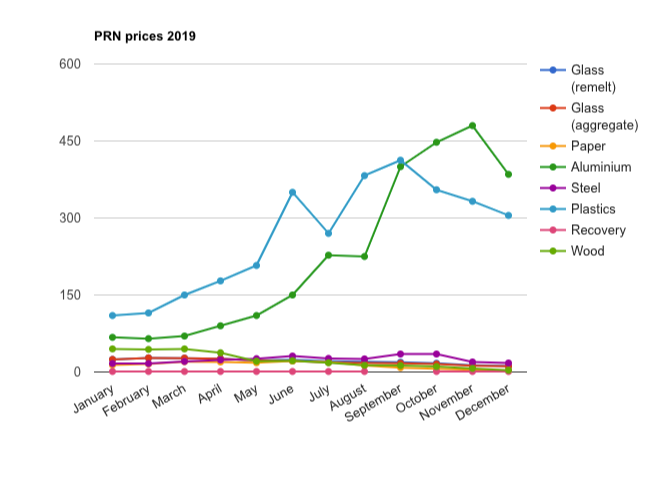
The high price, however, is yet to translate into any increase in recycling throughput.
A new mechanism for achieving cost recovery
In line with its new policy, the government wants to review the PRN/PERN system altogether in a bid to introduce extended producer responsibility schemes that will finally see producers bearing the full net cost of waste recovery.
Expansive consultations with industry are in the cards. As it stands waste market practitioners expect some sort of modulated fee system (which targets products at the point they are placed on the market) to replace the old system with the aim of penalising companies that use hard-to-recycle materials in favour of those who don’t. But some are also concerned by the complexities involved with managing, monitoring and enforcing the new system.
(FT Alphaville readers will probably not be surprised blockchain is doing the rounds as a potential technological solution on that front, which doesn’t really instil much confidence in terms of how this will be implemented on the ground. But let’s not digress.)
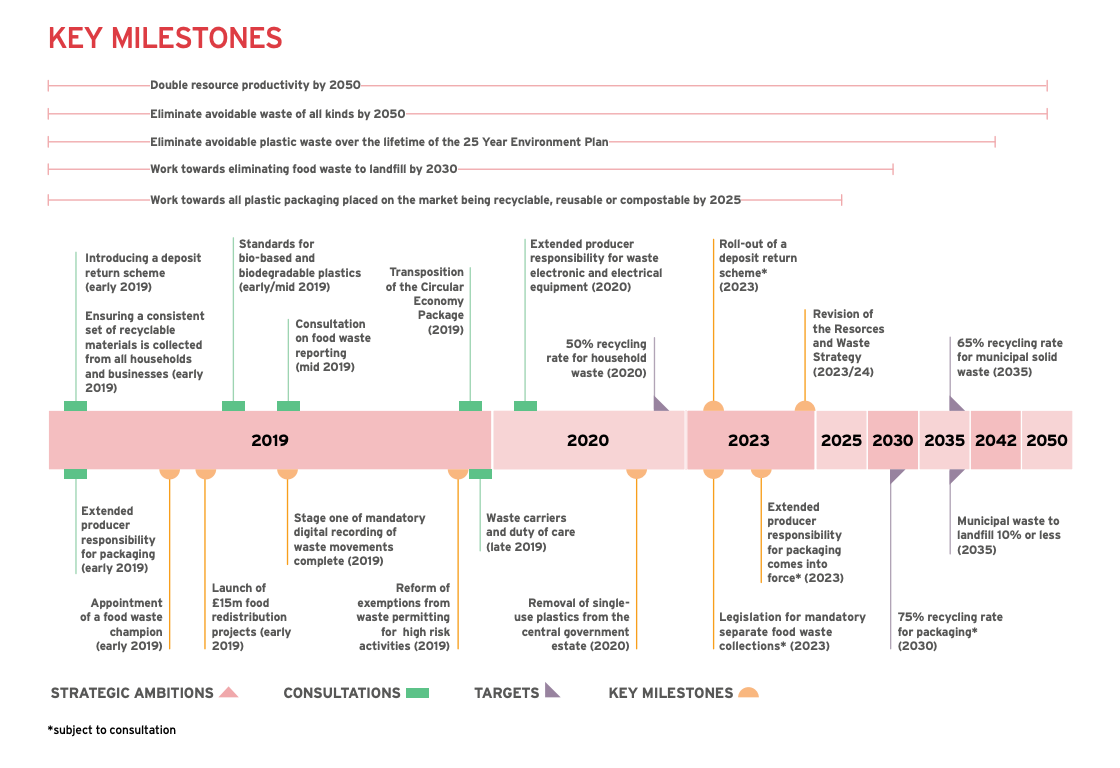
The bigger point is that most waste industry professionals agree the government’s policy as a whole is hugely ambitious, not least because it targets an epic 65 per cent recycling rate for municipal waste by 2035. This, they say, is going to be especially hard to achieve given that even perfect sorting and collection behaviour leads to a waste rate of about 15 per cent down to the wastage in the recycling process itself.
The government’s timeline nonetheless looks like this:
So far, so fascinating. But there are other even more interesting things going on.
It stands to reason there will be unintended consequences associated with applying taxes, penalties and incentives to transform something we currently discard and reject, into something we care about and value. Key among those is market opportunism and criminal behaviour.
New opportunity costs
Policies intended to discourage the use of landfill in favour of recycling (mostly by synthetically increasing the cost of landfill by applying taxes), have already led to a rise in unscrupulous operators prepared to engage in illegal dumping or the running of illegal waste sites due to how profitable such action is in the face of minimal enforcement and criminal penalty.
The Chinese import ban, meanwhile, has led to suspected PERN issuance fraud, with the number of PERNs claimed far outnumbering the amount of plastics actually exported as recorded by HMRC.
Waste professionals are also concerned extended producer responsibility schemes could lead to unhealthy market opportunism too. This is especially the case if the system is so harsh it incentivises producers to roll out a wide array of corporate-operated deposit return schemes (where product surcharges are introduced to incentivise customers to return used material in exchange for the return of their deposit). By adding so much complexity to the household waste management system, the concern is good household recycling behaviours will be upended, while a whole new level of organised criminal/opportunistic activity focused on exploiting deposit value will be incentivised.
Government concern
Indeed, organised waste crime is now such a concern the government last week announced a new dedicated unit focused on bringing together law enforcement agencies and UK environmental regulators to target waste criminals.
As they noted in the announcement (our emphasis):
The Joint Unit for Waste Crime (JUWC) will for the first time bring together law enforcement agencies, environmental regulators, HMRC and the National Crime Agency in the war against waste crime.
Serious and organised waste crime is estimated to cost the UK economy at least £600 million a year and a 2018 Home Office review found that perpetrators are often involved in other serious criminal activity, including large scale fraud and in some cases modern slavery.
To tackle the growing trend in criminal waste networks, the new unit will conduct site inspections, make arrests and prosecutions and, upon conviction, push for heavy fines and custodial sentences.
Some, such as Sir James Bevan, the chief executive of the Environment Agency, have even described waste crime as the “new narcotics”. (Though anyone who watches The Sopranos wouldn’t be too surprised by that linkage. )
Consider this post a curtain raiser to the twist and turns that are likely to develop across the sector as the new policies take hold.










