








The latest push by pro-coal lobbyists and some Coalition MPs – for the clean energy target proposal to be dropped in favour of a reverse auction that could be used to fund a new coal power station – has left analysts wondering if they are actually trying to “blow up” the debate.
The idea was raised, after the Minerals Council of Australia – the coal lobby – suggested it to Coalition backbenchers, as part of a campaign against chief scientist Alan Finkel’s clean energy target.
The idea, as outlined by Craig Kelly, head of the Coalition’s backbench energy and environment committee, is that the reverse auction would set an emissions cut-off that would allow so-called “high-efficiency low-emissions” coal power plants to compete but which would allow renewables to win if they provided the cheapest power, with the required level of reliability.
Given that renewable energy is the cheapest, how could such an auction be engineered to let coal win?
Rigging a reverse auction for ‘baseload’ energy is not enough
A totally open reverse auction that sought the cheapest form of generation would never see a coal power plant winning any funding.
A reverse auction for electricity generation usually works by the government offering to buy the electricity from the new power plant for some period of time. The bidders then offer to build and supply electricity at the lowest price they can, and the cheapest bids win.
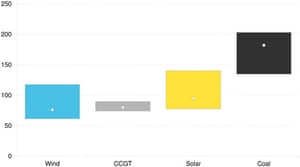
A so-called “high-efficiency low-emissions” (HELE) coal power plant would not be able to bid to sell its electricity as cheaply as wind, solar or gas. Estimates vary but, according to Bloomberg New Energy Finance, the cost of energy from a new coal power plant would be $134 to $203 per megawatt hour. Other groups have estimated it lies somewhere between $100 and $250/MWh.
That’s more expensive than wind, solar or highly efficient combined-cycle gas.
Reverse auctions were used successfully in the ACT to help it successfully implement a 100% renewable energy target. But one of the useful things about the system, as it worked there, was that a reverse auction can be designed to impose any restrictions you like on the sorts of projects that can bid. In the ACT, they required a number of extra conditions, including ones related to economic development and community engagement.
That makes it potentially the perfect mechanism if you want to impose conditions that will ensure coal can win.
Simon Corbell, who was the deputy chief minister and minister for the environment and climate change in the ACT, and oversaw the implementation of the reverse auction system there said: “A reverse auction is designed to achieve real price discovery for energy generation but it also allows you to build in other criteria that have regard to factors other than price.”
“A reverse auction should work to deliver the best possible price as well as the other outcomes. That’s the way it should be administered – but you certainly could engineer a reverse auction process to support an otherwise expensive technology like coal,” Corbell said.
So what conditions would the Coalition need to impose on a reverse auction to make sure that a coal power plant won?
It wouldn’t be enough to demand that the power stations provide power when it’s needed.
The research firm RepuTex recently produced a report comparing the cost of electricity from newly built generators, and compared like-for-like but looking at the cost of providing flexible power as well as baseload power.
They found the cheapest power plants that provide electricity flexibly throughout the day is wind and solar, with pumped hydro storage. And coal is beaten by several other technologies, including combined cycle gas, solar thermal with storage, pumped hydro that charges from the grid, as well as other forms of gas generation.
And when it comes to peaking plants – that are very fast to turn on and just provide electricity during periods of peak demand – coal is a terrible option. It’s beaten on price by solar with battery storage, solar thermal, gas, diesel and batteries charged from the grid.
But, interestingly, Reputex found that even if a reverse auction looking for power that was always on regardless of when it was needed – baseload power – HELE coal still wouldn’t compete.
It found old-fashioned high-polluting coal is still the cheapest. But the government hasn’t suggested that sort of plant would be considered. HELE coal is beaten on price for baseload power by both gas and geothermal.
Dylan McConnell from the University of Melbourne suggests it would be possible to rig an auction in favour of coal by insisting on other conditions for entry to the auction, which might tip the balance in favour of coal.
One way would be to insist that eligible power plants must have “real inertia”, he says, which would require that the plant have large spinning turbines and rules out technologies like batteries and that provide the same reliability.
That might knock out some otherwise cheaper forms of “baseload” power. However, given that baseload power is no longer needed, adding further unnecessary requirements is clear gerrymandering.
The draft energy security target in South Australia has this requirement of “real inertia” but there McConnell says coal power won’t be viable, so it will just mean the target is for gas generation.
“Given current gas prices – I guess it wouldn’t be hard to imagine a scenario where similar constraints would basically mean it could favour coal,” McConnell says.
Location, location, location
Tristan Edis, an analyst at the research and advisory firm Green Energy Markets, points out coal power stations are further limited by the requirement of being located near a source of good-quality coal.
“A coal plant makes no sense in Victoria and South Australia because they have poor-quality coal that would mean the power plant had very high carbon emissions not much better than existing coal plants in NSW and Queensland,” he says.
Meanwhile, Queensland already has about 8,000MW of coal generation capacity in a state whose average electricity demand is about 6,000MW, he says.
“So that leaves NSW, which should be able to count on the extra 2,000MW from the Snowy Hydro upgrade to meet its reliability needs if the federal government is to be believed,” he says.
All that leaves little room to see how a coal power plant that is cleaner than existing ones could ever be built in Australia.
Carbon risk needs to be nationalised
But even if a reverse auction were rigged to demand “baseload” power, as well as “real inertia”, and then the emissions baseline were set high enough to allow low-quality Victorian coal to be used, most analysts say the power station would need large subsidies to make it financially viable.
The biggest risk it would face – and one investors are keenly aware of – is that of a serious carbon price in the future.
Tim Buckley, an analyst at the Institute for Energy Economics and Financial Analysis (Ieefa), says that, to attract investment, you would also need to guarantee the coal power plant would be exempt from any future carbon pricing.
However, even then more might be needed to get financing over the line, he says. But if the government would provide low-cost financing – with a loan through something like the Northern Australia Infrastructure Facility or the Clean Energy Finance Corporation – a coal power station would be “home and hosed”, Buckley says.
“And we, the taxpayer, are on the hook for capital risk over 40 years,” he adds.
Pro-free-market lobby twists in contortions
“What is surprising is organisations like the [Minerals Council of Australia], who would normally be in favour of a more market-based approach, seem to be embracing a direct government intervention – effectively renationalisation approach,” says Tony Wood, the director of the energy and program at the Grattan Institute.
Wood says it’s effectively a renationalisation proposal, since all the risk is transferred from the investor to the taxpayer, or the consumer, through some sort of legislative mechanisms.
“I’m staggered that members of the Minerals Council would even support such a thing. It’s bizarre.”
Putting it all together, if such a system were to actually support a HELE coal power plant, it would need to gerrymander the auction to only allow generators to bid into it that had unnecessary qualities like “real inertia”.
It would also likely need to provide government-backed cheap finance and a guaranteed exemption from any future carbon pricing. And, even then, it’s not clear a suitable location could be found for a HELE coal power plant that actually had lower emissions than existing plants in NSW.
And, on top of it all, it appears to require an ideological backflip from the supposedly free-market Minerals Council of Australia to back a renationalisation approach to Australia’s energy generation.
All that leaves Wood wondering if the Minerals Council’s strategy here is actually just to “blow up” the whole discussion.
“One must question whether this contribution from the Minerals Council is a genuine attempt to contribute to constructive energy and climate policy or a repeat of their previous strategies for which the attempt is fundamentally to blow up the whole debate.”










